
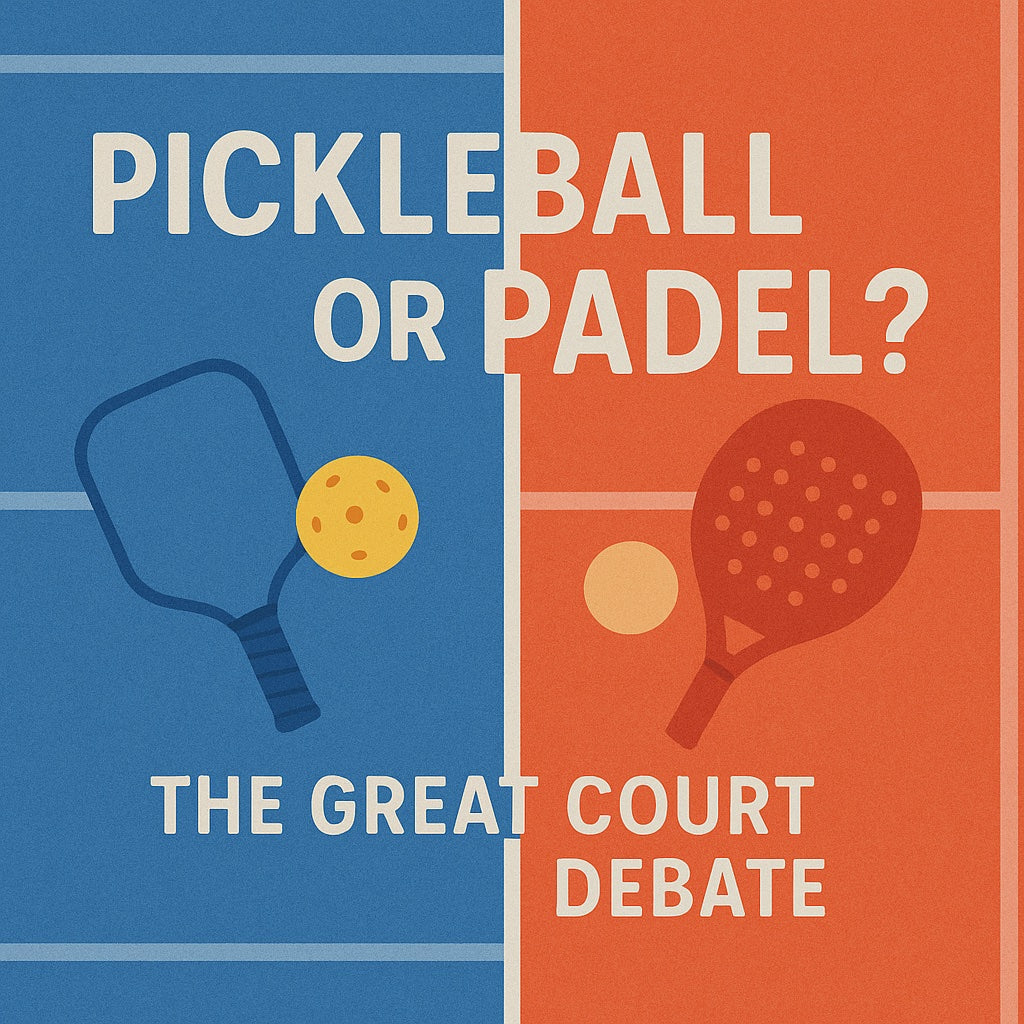
Let’s get one thing straight: I’ve played both. I’ve chased a depressurized padel ball off a glass wall at 9 p.m. in Madrid while sipping a caña between points, and I’ve dinked a neon Wiffle ball at 7 a.m. in a Florida parking lot while retirees heckled my foot faults. Both sports are addictive, both are social rockets, and both are currently colonizing every available slab of concrete from Dubai to Delaware. But they’re not twins. They’re not even cousins. They’re more like that one friend who swears tennis is “basically padel with worse walls” and the other who calls pickleball “tennis for people who hate running.”
So grab a paddle (whichever kind), because we’re breaking this down like a third-shot drop: court, gear, rules, vibes, and who actually wins when the dust (or sand) settles.
The Court: Walled Garden vs. Open-Air Kitchen
Padel plays like tennis got locked in a glass box and learned to love it. The court is 20x10 meters—about a third the size of a tennis court—enclosed by 3-4 meter walls (glass on the ends, mesh on the sides). You use those walls. A ball ricochets off the back glass? Still in play. Smash it into the side mesh after a bounce? Legal. It’s chess with cardio, rewarding angles, lobs, and patience. Miss the wall? You’re not out—you’re just giving your opponent a free geometry lesson.
Pickleball is the minimalist rebel. 20x44 feet (yes, feet), flat as a driveway, with a 7-foot no-volley “kitchen” zone taped 7 feet from the net. No walls, no mercy. The ball dies on contact with anything but the court, so every shot is a commitment. It’s ping-pong’s hyperactive grandson—fast, low, and unforgiving to anyone who thinks “smash” is a personality trait.
Winner? Padel for strategy nerds. Pickleball for reflex junkies.
The Gear: Squishy Balls and Fancy Rackets vs. Wiffle Balls and Foam Bats
Padel gear looks like tennis cosplay. The paddle is solid—perforated foam core, carbon or fiberglass face, no strings. It’s heavier (350-380g) and built for control, not power. The ball? A depressurized tennis ball that bounces lower and slower, forcing you to earn every point. You’ll pay $120-400 for a paddle that lasts years and $6 for three balls that feel like sad tennis rejects.
Pickleball is the thrift-store chic of racket sports. Paddles are composite or carbon, lighter (220-260g), with a honeycomb core that pops like a muted gunshot. The ball is a perforated plastic Wiffle—loud, light, and merciless in wind. A top paddle runs $80-250, and balls are $2 each. You’ll replace them when they crack, not when they wear out.
Winner? Pickleball for wallet warriors. Padel if you want gear that feels premium and lasts forever.
The Rules: Rally Scoring vs. Side-Out Shenanigans
Padel uses rally scoring (first to 6 games, best of 3 sets, deuce at 40-40 needs two points). Serve underhand from below the waist, diagonal into the box. After the bounce, anything goes—walls, glass, your opponent’s ego. Doubles only (singles exists but is rarer than a quiet MLP crowd).
Pickleball is side-out scoring (only the serving team scores, 11 points to win, must win by 2). Underhand serve below the waist, diagonal, must clear the kitchen on the return. The infamous double-bounce rule: serve and return must bounce once before volleys. Then it’s kitchen chaos—volley away, but step in the NVZ on a volley and you’re toast.
Winner? Padel for flow. Pickleball for drama (and arguments about kitchen lines).
The Learning Curve: 10 Minutes vs. 10 Months
Pickleball is the ultimate gateway drug. You can rally in 10 minutes, compete in 10 hours, and argue with strangers about rules in 10 days. The soft ball and small court forgive sins. But mastery? That’s a different beast—dinking, third-shot drops, and stacking take years.
Padel demands respect. The walls punish the impatient and reward the tactical. You’ll need 10 sessions to stop smashing into glass and 10 months to read angles like a pro. But once it clicks? It’s poetry with sweat.
Winner? Pickleball to start. Padel to stay.
The Social Scene: Sangria on the Terrace vs. Coolers in the Parking Lot
Padel is European elegance—post-match beers on the club terrace, four friends laughing about that one lob that kissed the back wall twice. It’s 90 minutes of doubles, conversation, and community. Global footprint: 25 million players, 100,000+ courts, exploding in the Middle East and Latin America.
Pickleball is American chaos—folding chairs, Yeti coolers, and 70-year-olds trash-talking 20-somethings. Round-robins, drop-ins, and “who brought the watermelon?” It’s 30-minute games, 4 courts deep, and a waitlist longer than a Ben Johns rally. 14 million players in the U.S. alone, 50,000+ courts, and growing faster than HOA complaints.
Winner? Tie. Padel for vibes. Pickleball for volume.
The Verdict: Pick Your Poison
-
Play padel if: You love strategy, walls, and a sport that ages like wine.
-
Play pickleball if: You want instant action, accessibility, and a community that adopts you like a stray dog.
-
Play both if: You’re me, and your garage looks like a racket sport museum.
Neither is “better.” They’re different languages for the same love: four people, a net, and the primal joy of sending a ball where your opponent isn’t. Padel is the slow-burn romance. Pickleball is the one-night stand you text the next morning.
So lace up, grab whichever paddle calls your name, and get on a court. The walls are waiting. So is the kitchen.
Now, tell me in the comments: Which one are you defending to the death? Let’s argue like it’s game point.

Leave a comment
All comments are moderated before being published.
This site is protected by hCaptcha and the hCaptcha Privacy Policy and Terms of Service apply.